Bromm: The Anatomy of a High-Impact Display Typeface
In the vast ecosystem of typography, the distinction between a typeface that merely conveys information and one that captures attention is often defined by its intent. While serif and sans-serif fonts serve the structural backbone of long-form reading, display typefaces operate in a different realm entirely. They are the visual equivalent of a shout, a whisper, or a dramatic pause. Bromm enters this arena not just as a font, but as a visual statement, designed specifically to disrupt the ordinary flow of design. For professionals and creators, understanding the mechanics and applications of a decorative display font like Bromm is essential for mastering visual hierarchy and brand identity.
The Philosophy of Decorative Display Fonts
To appreciate the utility of Bromm, one must first understand the category of "display" typography. Unlike text fonts, which are optimized for legibility at small sizes over long paragraphs, display fonts are engineered for short bursts of high visibility. They are intended to be seen at large sizes, typically in headlines, posters, and logos. The primary goal of a display font is not just reading, but feeling. It conveys a mood—be it luxury, grunge, retro, or avant-garde—before the viewer has even processed the words themselves.
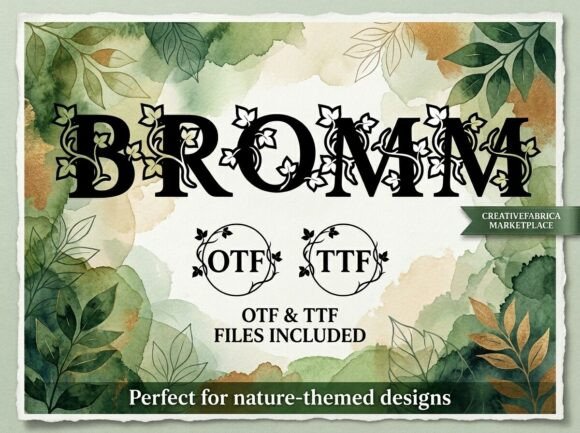
Bromm is characterized by its strong visual personality and unique artistic elements. This is a typeface that refuses to blend into the background. It is designed for creators who want to break away from the ordinary. In a market saturated with clean, geometric sans-serifs, a font with the distinct character of Bromm offers a necessary counterpoint. It provides the "flavor" that standard utility fonts lack. However, this specialization comes with specific rules of engagement. It is not a workhorse for body text; it is a precision instrument for visual impact.
Technical Architecture: OTF vs. TTF
When acquiring a professional typeface like Bromm, the delivery of the files is just as critical as the design. The package typically includes two primary file formats: OTF (OpenType Font) and TTF (TrueType Font). Understanding the difference between these two is a hallmark of a professional workflow.
The OTF file is the professional standard for advanced design and layout software. It utilizes the CFF (Compact Font Format) outline format, which generally offers higher quality rendering and superior compression. For designers working in Adobe Creative Suite (Illustrator, InDesign, Photoshop) or Affinity Designer, the OTF version of Bromm is the preferred choice. It supports advanced typographic features and maintains the integrity of the artistic letterforms across complex design manipulations.
The TTF file, on the other hand, ensures universal compatibility. It is the standard for operating systems and works seamlessly across all devices, from desktops to mobile phones. While TTF files are larger and slightly less sophisticated in their hinting algorithms compared to OTF, they are indispensable for web use (via web font converters) and for ensuring that the font renders correctly on every user's machine. For a font like Bromm, which relies heavily on visual fidelity, having both options ensures that the design intent is preserved whether in print or on screen.
The "All-Caps" Constraint: A Deliberate Design Choice
One of the most defining characteristics of Bromm—and a crucial point of consideration for users—is that it is an ALL-CAPS, uppercase-only display typeface. This is not an omission; it is a deliberate design decision. In typography, there is a significant difference between a standard font that has simply been set in uppercase and a typeface designed exclusively with uppercase forms.
Standard fonts, when set in all caps, can often look awkward because the letter spacing (kerning) and vertical metrics are designed for mixed case. In contrast, Bromm’s letterforms are crafted to sit together harmoniously as uppercase units. The shapes are often bolder, more geometric, and more balanced when viewed as a cohesive block of capitals. This design choice reinforces the font’s purpose: it is not meant for reading; it is meant for viewing.
This constraint guides the user toward best practices. Because it lacks lowercase letters, Bromm should never be used for long sentences or body copy. Attempting to read a paragraph of all-caps text is cognitively taxing for the human eye. Instead, the uppercase limitation forces the designer to use the font surgically—applying it only where maximum impact is required, such as a single powerful word or a short, punchy slogan.
Strategic Applications: Where Bromm Excels
The versatility of Bromm lies in its ability to adapt to high-impact scenarios across various industries. Its strong visual personality makes it a candidate for specific, high-stakes design tasks.
Logo Design and Wordmarks
A logo must be memorable, and typography plays a massive role in brand recall. Bromm’s unique artistic elements make it an excellent candidate for wordmarks. Because the letters are designed as "works of art," a logo built with Bromm requires minimal additional graphic elements to stand out. It is particularly effective for brands in the creative, entertainment, or luxury sectors that want to project confidence and distinctiveness.
Creative Packaging
In the retail environment, a product has roughly three seconds to capture a shopper's attention. Packaging design relies on display fonts to bridge the gap between the product and the consumer. Bromm is versatile enough for bold headlines on packaging, whether for artisanal food products, cosmetics, or streetwear. Its polished finish ensures that while it is artistic, it does not look amateurish or chaotic on the shelf.
Editorial and Poster Design
For magazine covers, event posters, or book covers, the headline does the heavy lifting. A font like Bromm can set the tone for the entire publication. For example, a music festival poster using Bromm immediately signals a modern, artistic vibe. Similarly, in editorial design, using Bromm for drop caps or section headers can break the monotony of standard serif text, guiding the reader’s eye to specific entry points.
Implementing Bromm: Workflow Considerations
For designers and creators looking to integrate Bromm into their projects, a few workflow considerations will ensure the best results.
First, spacing is key. Because Bromm features unique artistic elements, the default letter spacing provided by the software may not always be perfect for every context. Display fonts often benefit from slightly tighter tracking (letter spacing) to create a solid, impactful visual block. However, because the letters are all uppercase and may have intricate details, care must be taken not to kern them too tightly, which could cause overlapping or visual clutter.
Second, color and contrast. Decorative fonts like Bromm often carry a lot of visual weight. They perform best when given room to breathe. Placing Bromm on a busy, textured background can render the text illegible. Instead, pair the font with solid, high-contrast backgrounds. If the font features thick strokes, a dark background with light text (reversed out) can look particularly striking, emphasizing the "polished finish" of the typeface.
Third, pairing with secondary fonts. Since Bromm is a display typeface, it requires a partner font for any supporting text (subheadings, body copy, captions). The best practice is to contrast the style. If Bromm is decorative and bold, pair it with a clean, neutral sans-serif or a classic serif. This contrast creates a visual hierarchy that is pleasing to the eye. Avoid pairing Bromm with other decorative fonts, as this will result in visual competition and a cluttered layout.
The Role of Typography in User Experience
While often associated with print, fonts like Bromm play an increasingly vital role in digital user experience (UX) and web design. In the era of "hero" sections—large, immersive introductory areas on websites—a strong display font is essential. Using Bromm for the main h1 tag on a landing page can instantly communicate the brand's personality to a visitor.
However, web implementation requires technical care. As a decorative font, Bromm may have larger file sizes than standard system fonts. Designers must ensure proper optimization so that the font does not slow down page load times. Techniques such as subsetting (removing unused characters to reduce file size) and using modern font-loading strategies are vital. While the font file includes standard characters, ensuring that the "all-caps" nature is communicated to the user interface—perhaps by forcing text-transform: uppercase in CSS—is a good redundant measure to maintain design consistency.
Conclusion
Bromm represents a specific solution to a specific design challenge: the need for high-impact, artistic typography. It is not a replacement for the standard fonts used in daily communication, but rather a specialized tool for moments of visual emphasis. By understanding its all-caps nature, utilizing the correct file formats (OTF for print, TTF for compatibility), and applying it to appropriate use cases like logos, headers, and packaging, designers can leverage Bromm to create work that is not only professional but genuinely captivating. In a world of noise, a font like Bromm offers the clarity of a distinct voice.