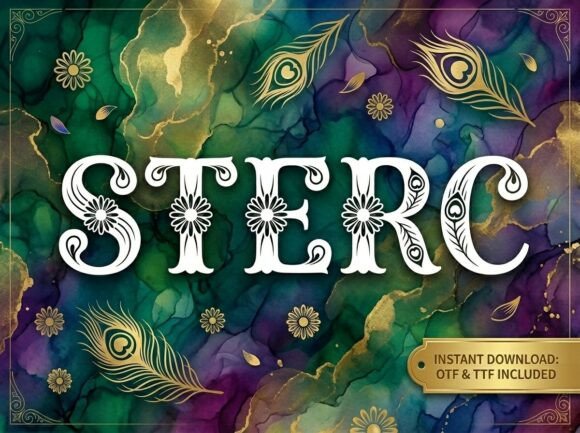
Sterc Font: Evaluating a Decorative Display Typeface for Bold Design Projects
When searching for a typeface that commands immediate attention, designers often encounter a category known as display fonts. Within this space, the Sterc font presents itself as a distinct option, characterized by its artistic flair and strong visual personality. It is designed not for body text, but for moments where typography itself becomes a focal point of the design. Understanding its specific characteristics, strengths, and inherent limitations is key to determining if it aligns with your creative objectives.
Core Characteristics and Design Philosophy
Sterc is best described as a decorative, all-uppercase display typeface. Its design philosophy centers on creating a high-impact visual statement. Each letterform is crafted with unique artistic elements, giving the font a polished yet unconventional look. This makes it particularly suited for applications where brevity and visual punch are paramount. Think of bold headlines that need to stop a viewer in their tracks, artistic logos that require a memorable mark, or creative packaging where the product name itself needs to exude character and style.
The font's "all-caps" nature is a fundamental design choice, not an oversight. This characteristic enforces a sense of uniformity and strength across a word or phrase, eliminating the variable x-height and ascenders/descenders of mixed-case typography. The result is a consistent, block-like presence that can feel more like a graphic element than traditional text. It is specifically engineered for scenarios where every letter is treated as a standalone artistic unit, contributing to an overall decorative composition.
Practical Applications and Use-Case Scenarios
Evaluating a font like Sterc involves mapping its traits to specific project needs. Its strengths are most apparent in short-form, high-visibility contexts.
- Headlines and Titles: For magazine covers, poster titles, or section headers on a website, Sterc can deliver a powerful and stylish opening. Its decorative nature ensures the headline is not just read but visually experienced.
- Logo and Branding Marks: When a brand seeks a logo that feels unique, artistic, and slightly avant-garde, Sterc offers a compelling starting point. The all-caps structure provides a solid, confident base for a logotype.
- Short Text in Creative Layouts: In editorial design, it can be used for pull quotes, chapter titles, or feature article headers where adding visual interest is a priority. Similarly, for event invitations or album artwork, it helps establish a specific artistic mood.
However, its suitability diminishes rapidly in other areas. It is not designed for reading at length. Using Sterc for paragraphs, body copy, or even lengthy subheadings would compromise readability and likely overwhelm the viewer. Its detailed letterforms can become visually noisy when set at small sizes or in large blocks.
File Formats and Technical Considerations
Sterc is typically distributed in two standard font file formats: OTF (OpenType Font) and TTF (TrueType Font). Understanding the difference helps in planning your workflow.
- The OTF file is the professional standard. It supports advanced typographic features and is optimized for modern design and layout software like Adobe Creative Suite applications. If your work involves complex typographic compositions, the OTF file is the preferred choice.
- The TTF file ensures broad compatibility. It works reliably across virtually all operating systems and applications, including older software and basic word processors. This format is useful if you need to share the font with clients or team members who may not have specialized design software.
Providing both formats is a practical consideration, offering flexibility depending on the project's technical environment and the user's software ecosystem.
Weighing Sterc Against Alternatives and Approaches
No typeface exists in a vacuum. When considering Sterc, it's helpful to compare it to broader categories and alternative approaches to achieve a similar goal.
Compared to more traditional serif or sans-serif display fonts, Sterc leans heavily into the decorative category. Fonts like a bold condensed sans-serif might offer impact with greater neutrality, while a classic serif display font could provide elegance with more traditional readability. Sterc's trade-off is that it prioritizes unique artistic expression over neutrality or traditional form.
An alternative approach is to use a standard font family with a dedicated "display" or "headline" weight and style. This can offer a more cohesive system for a project, allowing the display font to connect stylistically with a body text font from the same family. The decision here hinges on whether you need a standalone artistic element (favored by Sterc) or a component within a larger typographic system.
Another consideration is the use of custom lettering or illustration. For a one-off logo or a single headline, commissioning custom lettering can yield a perfectly unique result. However, this is a significantly more resource-intensive process. Sterc provides a ready-made, high-quality artistic solution that can be implemented immediately, offering a middle ground between standard fonts and bespoke creation.
Decision Factors: Is Sterc the Right Choice for You?
Choosing Sterc should be a deliberate decision based on specific project criteria. It is likely a good fit if:
- Your primary need is for short, high-impact text like logos, titles, or badges.
- You are aiming for a bold, artistic, or unconventional aesthetic.
- You understand and accept the all-uppercase limitation as a stylistic feature that serves the design.
- You have verified that its specific character set meets your project's needs (e.g., language support, specific glyphs).
Conversely, you may need to explore other options if:
- Your project requires extensive text setting or prioritizes maximum readability.
- You need a versatile family with multiple weights (light, regular, bold) and styles (italic) for a cohesive design system.
- The all-caps constraint is a practical hurdle, such as for displaying proper nouns or acronyms that traditionally use lowercase.
- You are working on a project where neutral, understated typography is the goal.
Ultimately, evaluating a font like Sterc is an exercise in matching tool to task. Its value lies in its specific, unapologetic character. By assessing your project's goals, audience, and required text length, you can determine if its strengths in decorative impact align with your needs, or if a more versatile or conventional typeface would better serve your design's purpose. The most informed choice comes from understanding not just what a font is, but precisely where and how it performs best.